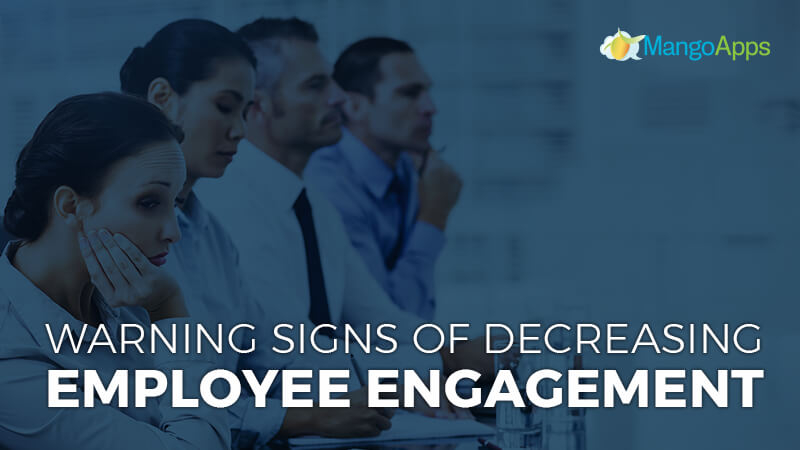
As a manager, few things are more discouraging than receiving a resignation from out of the blue. Realizing that a good employee is unhappy at work can come as a shock, especially when it seemed like everything was going well. Decreasing employee engagement, especially in previously motivated employees, is a serious problem for organizations. Disengaging attitudes can do a lot more than just cost companies a valuable employee. Negative work perceptions can become contagious and could lead to serious problems in the long run. It is critical to recognize decreasing employee engagement in its early stages. If caught early, companies can address issues and clarify misconceptions right away, helping them retain strong employees. To help managers and supervisors with this effort, we have identified the 7 warning signs of decreasing employee engagement.
#1: Declining Quality Of Work
While it might seem obvious, declining work quality is one of the first signs of decreasing employee engagement. When employees no longer feel connected to their company they often struggle to put forth their best effort. If an employee starts to exhibit lower levels of work quality, it is important to handle the situation appropriately. Rather than punishing or issuing a warning, try to have a discussion and figure out the real cause of the problem. Working with an employee to overcome problems is usually much more effective than angry lectures or punishments. Evaluate their past performance and try and find where work quality began to decline. Communicate honestly about your concerns and work together to find a solution.
#2: Silence From A Spokesperson
When an outgoing influencer suddenly stops speaking up, it is almost always a sign of decreasing employee engagement. Outspoken employees tend to be passionate and persuasive, and can cause negative feelings throughout the organization. It is essential for an employer to understand what action triggered this change of behavior. While employees will not always agree with company decisions, disengagement often stems from misconceptions. Try to talk with your employee and gain perspective for why certain decisions were made. After addressing concerns and clearing up misconceptions, he or she may even become a spokesperson for the policy change or action, helping other employees stay engaged and onboard.
#3: Disinterest In Collaboration
A collaboration tool can make it easier for coworkers to communicate and shows admins important metrics about how employees are interacting with each other. This data helps employers see when a disinterest in communication and collaboration occurs. Reluctance to work with their peers is another important warning sign of decreasing employee engagement. This reluctance can be from a single employee, a team, a branch, or even across the entire organization. Understanding employee collaboration efforts help employers understand important sentiments within the organization. This rings especially true when there is an unexpected drop in engagement levels. Prolonged phases of reduced social engagement should never be left unattended and companies should do their best to assess concerns as soon as possible.
For a deeper look at this topic, read our whitepaper “Employee Engagement Is No Longer Optional”
#4: Skipping Office Activities
Sometimes, you may not recognize an employee’s disengagement by looking at their performance. Disengaged employees might work brilliantly, execute goals, and receive outstanding evaluations, but work performance should never be considered the only indicator of engagement levels. While avoiding company games or organized social events doesn’t always mean decreasing employee engagement, it can be a sign of unhappiness or disinterest in the company culture. This is particularly true if the employee was previously active and involved in office activities. Even though their work performance may not be suffering, disinterest in company culture is still important and could play a major role in your employee’s happiness and work satisfaction.
#5: Increased Irritation or Anger
If an employee suddenly seems angry or lashes out at others over the smallest issue, it is a sign of decreasing employee engagement. When employees mentally disconnect from a company it becomes more difficult to see coworkers and managers as part of their team. As a result, employees become much less patient and understanding of others in the workplace. Small annoyances may start to feel like compounding problems, especially if the real reasons for disengagement have not been discussed. HR personnel or their respective managers need to step in and diffuse the situation by addressing the real problem. However, increased irritation may also be due to problems that are not work-related. HR members should do their best to observe and consult with the employee to understand and address any underlying work-related issues.
#6: Unusual Performance Scores
A collaboration tool can help employers manage employee engagement by making it easier to track employee performance. This could involve attendance logs, completion timelines, to-do lists, key performance indicators, and much more. Insights about employee performance can alert admins to changes in employee performance right away, helping them address concerns as they occur. When approaching an employee about his or her performance, be sure not to micromanage. Approach the situation with the goal to work together with employees to identify problems and find solutions.
#7: Pessimistic About Challenges
Engaged employees are excited about work and the role they play in an organization. They take on new challenges with enthusiasm and see them as opportunities to be creative and showcase their abilities. When employees experience decreasing engagement, challenges become burdens rather than motivations. This is particularly true when employees have always been quick to act and take on new tasks in the past. When an employee does not show his or her characteristic enthusiasm it is a clear indication that something is going on. Talk to employees about their work satisfaction or ask them about which project they would be interested in based on their talents and skills.
MangoApps
Decreasing employee engagement doesn’t have to take you by surprise. With a little extra attention and some helpful tracking tools, your organization can overcome these employee engagement obstacles, and address concerns right away. MangoApps includes all of the reward and recognition tools employers need to build happy cultures, productive companies, and unmatched success.
To learn more about how MangoApps can increase employee engagement, contact us or schedule a demo with us today.
The MangoApps Team
We're the product, research, and strategy team behind MangoApps — the unified frontline workforce management platform and employee communication and engagement suite trusted by organizations in healthcare, manufacturing, retail, hospitality, and the public sector to connect every employee — deskless or desk-based — to the people, tools, and information they need.
We write about enterprise AI for the workplace, internal communications, AI-powered intranets, workforce management, and the operating patterns behind highly engaged frontline teams. Our perspective is grounded in a decade of building for frontline-heavy industries and shipping AI agents, employee apps, and integrated HR workflows that real employees actually use.
For short-form takes, product news, and field notes from customer rollouts, follow Frontline Wire — our ongoing stream on AI, frontline work, and the modern digital workplace — or learn more about MangoApps.